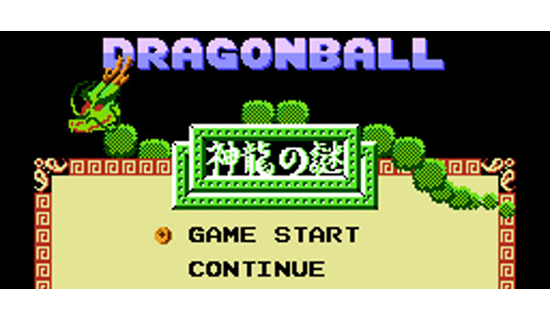

While not the very first Dragon Ball console game (that honor goes to an extraordinarily expensive Dragon Ball title on the Super Cassette Vision), this was the first on a console with a significant install base. There was never any doubt that the Dragon Ball franchise would spin-off into the world of home video games: The manga began its run in 1984, and the TV animation in 1986. This game covers the first major story arc in the Dragon Ball series, which involves Son Goku and friends gathering the Dragon Balls, foiling the plans of Emperor Pilaf, and finally summoning the wish-granting dragon Shen Long. For those not familiar with the progression of the Dragon Ball series, it wasn’t always the action heavy Dragon Ball Z in which a single fight could span over the course of a dozen episodes. The series started as a much more fun loving story of Goku and friends going on actual adventures, and meeting an assortment of wacky characters. Shen Long no Nazo is centered around this period of the series.
This was one of the first anime games that I’m aware of to use a version of its anime counterpart’s theme song, in this case “Makafushigi Adventure”, as the background music. Perhaps as a space saving technique or due to ineptitude by the game’s sound programmer, this song is on a very short loop. So if you’re not particularly fond of the song (or maybe even if you are), it very well may drive you crazy before too long.
It should also be mentioned that The Legend of Zelda was released by Nintendo on the Famicom Disk system in the earlier part of this same year. This would slowly but surely set a trend in motion of action/adventure games trying as hard as they possibly could to capture that magical feeling that Zelda gave off. Dragon Ball: Shen Long no Nazo was no exception, and it makes no attempts to hide its biggest influence. For this period in the Dragon Ball series though, it actually makes sense: Link was setting out on an adventure, and so was Goku.
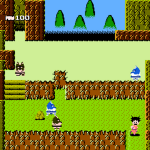 |  |
| Goku getting ready to take on the…dog army? | Dragon Ball: Now With Bears! |
So it shouldn’t come as any surprise that you’ll mostly be exploring different areas that Goku travels to throughout the series from a top-view perspective, and attacking enemies as you go along. You can collect various items from defeating those enemies on the map, or from wandering into one of the extremely well hidden areas. Like so many games of this vintage, there’s no real indication as to where they are: You’ll walk into a tree or rock and appear in a new room. The items to be found include health, better weapons (such as Goku’s staff Nyoibo) and stocks of the famous projectile attack Kamehameha for use of more difficult enemies. So basically use a guide or just try walking into everything that you see. This was probably their attempt to replicate the idea of having to burn every bush and bomb every wall to find secrets in Zelda, but it doesn’t feel quite as satisfying since you don’t have any of those tools to actually uncover these areas.
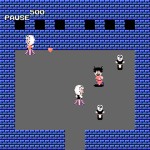 | 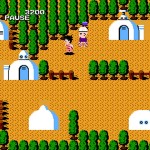 |
| A hidden room in which women of the village immediately fall in love with Goku and chase him around…but still cause damage | Villagers (or maybe construction workers?) come out to attack Goku, who is clearly an evil conqueror here for their village |
While you can see that they really did make some effort to get all of the sprites of actual Dragon Ball characters to look like those characters, many actually end up looking like they were scribbled out by children. Goku’s sprite doesn’t look too bad, but some of the rest are pretty far off. It’s also a little strange that so many of the enemies are various types of animal men or just regular human villagers. There’s some precedence for animal men being aggressors in the source material (particularly at the start of the series), but I don’t remember Goku ever being attacked by human villagers.
The amount of background detail put into the areas is pretty good for this time period though, even when compared to The Legend of Zelda itself. Individual rocks and various flora are more noticeable and less just a “part of the scenery”. That might just be because you get into the habit of walking into everything to see though.
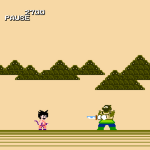
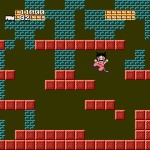 | 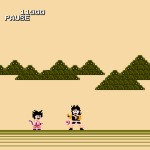 |
| Is Goku in a Super Mario Bros. level? Yes, he can even break those blocks with his head. | The third boss battle against Yamcha. Look, it’s an actual Dragon Ball character! |
Now for the game ruiner: Your life continuously ticks down, even when just walking around. Even for a reasonable early Famicom game, this is a baffling design decision! And it’s not like there’s any precedence for this in the original story either. Did they think that the game would either be too similar to Zelda, or too easy if they didn’t do something like this? It makes finding food items to replenish your health fairly frequently a necessity, but it’s really up to luck as to whether you get any before your life completely runs out. Collisions with or attacks from enemies will naturally deplete your health even faster, so you really have to be careful if you hope to last until the end of an area.
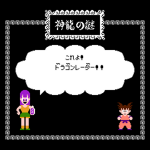 | 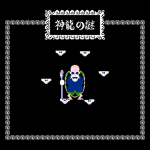 |
| An example of a “cutscene”: Goku and Bulma talking about the Dragon Radar | Muten Roshi thinking about his favorite thing in what is probably the game’s most iconic moment |
Despite its problems though, the game does a good job of capturing the feel of the early manga and anime. There are even small cutscenes with conversations between the characters throughout the levels that help to tell a very abbreviated version of the early Dragon Ball story. This is just another reason why this is so close to being a decent game. If it wasn’t for the ticking-down health, this would be a good Zelda clone. It wouldn’t be able to stand up to the real thing of course, but it would have been a great foot for Dragon Ball to put forward into the world of video games.
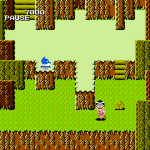 | 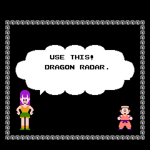 |
| The US version of the game, “Dragon Power” | The same “cutscene” from before, but in English |
Surprisingly, America also saw a release of this game in 1988, though the cartoon didn’t come to the west until the 90s. Because of this it was dubbed “Dragon Power”, and everything related to the Dragon Ball franchise was stripped out and replaced with the most generic Kung Fu nonsense that you can imagine. The Dragon Balls themselves became regular crystal balls and Goku’s sprite turned into one that arguably more accurately represents depictions of the actual monkey king Son Goku in other forms of media. Its most memorable change was probably the sprites of panties revolving around Muten Roshi’s head being replaced by sandwiches in the scene where he asks to see Bulma’s panties. I don’t think I have to point out that the dialog was obviously not translated by a native English speaker either.
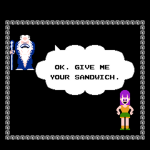 | 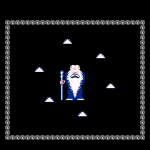 |
| Muten Roshi’s request to Bulma to show him her panties was turned into this in the US version | Ah sandwiches…wait, what did they do to Muten Roshi’s sprite?! |
For those who want to own this game but don’t care to hunt down the Famicom cartridge, you can pick up the DS title “Dragon Ball DS 2: Totsugeki! Red Ribbon gun” on which this is a playable extra.
I wish I could say that things would get better from here. The Dragon Ball series is about to sink into a deep, dark hole that it will not emerge from until the better part of the Famicom era has ended. Its new formula will likely leave you reminiscing fondly about this game before things get better again for this series.